
The Honolulu County Most Wanted List
No single Honolulu County sheriff's most-wanted roster exists. Hawaii's statewide Department of Law Enforcement, Sheriff Division handles courts, transport, process service, and state facilities. It does not publish the HPD arrest log, though. Two public wanted resources carry real local weight: HPD's Wanted Persons page, known as Na Maka, and the Honolulu CrimeStoppers wanted list.
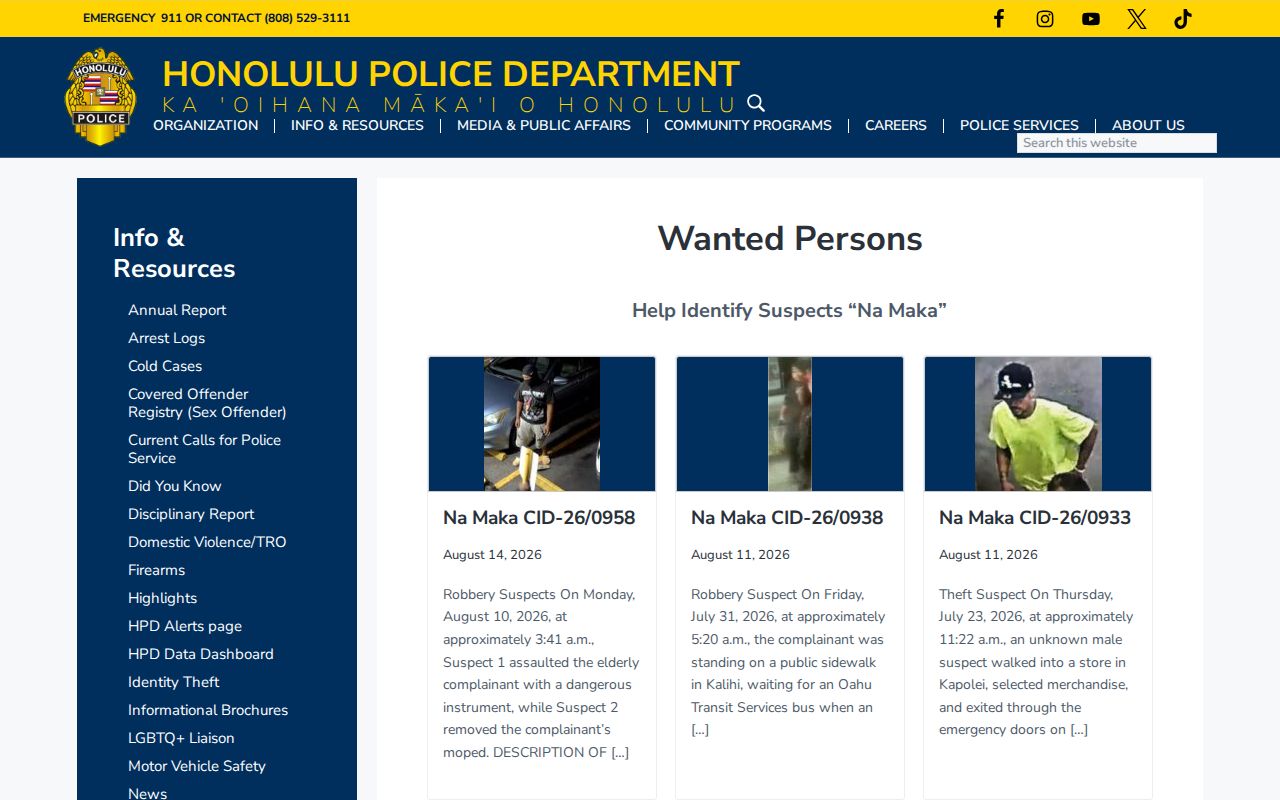
The Wanted Persons / Na Maka page has carried a rotating set of Criminal Investigation Division posts. Identifiers look like CID-26/0958, CID-26/0938, CID-26/0933, CID-26/0907, CID-26/0896, CID-26/0873, CID-26/0869, and CID-26/0839. The count shifts as posts come and go. Its purpose is to help the public identify suspects, not to catalog every active warrant or every person in custody.
Each post may include a photo, video, description, and a request for information. The image could be surveillance or investigation material rather than a booking photo. It will not show an arrest date, an HPD release code, or the public fields found in an adult arrest-log PDF. So treat a post as a lead. Follow its official contact instructions, and never copy or rehost an image.
The Na Maka capture below shows what this official suspect-identification channel looks like.
Need an arrest entry or booking photo instead? Use the countywide HPD record path on the Honolulu County record search page. A wanted post and a booking record answer two different questions.
What a Honolulu County Wanted Listing Shows
CrimeStoppers offers more structured fields than many HPD suspect posts. A listing can carry a warrant basis and a physical description. Even so, it works as a tip resource. Nothing more.
| Listing field | How to read it |
|---|---|
| Name or alias | The identity label used by the listing. Confirm identity with the responsible agency. |
| Photo or image | An identification aid. It may not be a booking photograph or a current likeness. |
| Warrant amount and type | A reported warrant detail that can change. Verify through HPD R&I or the issuing court. |
| Wanted-as-of date | The date attached to the listing, not proof that the warrant is still active today. |
| Physical description | Gender, race, age, height, weight, hair, and eye details when the listing provides them. |
| Tip instruction | The official route for information. It is not permission to confront or follow the person. |
Listings come down for several reasons. The person may have been located, the post may have changed, or the partner may have updated its records. A named person should reach out to counsel, the issuing court, or the responsible agency.
How to Read the Honolulu County Wanted List
Treat the list as an official tip and identification channel. Keep a web image separate from a warrant check, an HPD arrest entry, and any later court case. That separation keeps each step honest.
- Open HPD Na Maka or the Honolulu CrimeStoppers wanted list and note the date shown on the post.
- Read the name, alias, description, warrant detail, and tip instructions without assuming the picture is a mugshot.
- If you recognize someone, do not approach, follow, threaten, or try to detain that person.
- Send information through HPD, CrimeStoppers, or 911 when there is an immediate danger. Do not post private theories online.
- For a record question about an arrest, use the countywide HPD log, R&I photo request, and court path on Honolulu County Busted Mugshots.
Verification belongs with the responsible agency. A listing may reflect a bench warrant, a probation issue, a failure to appear, or an investigative request. Personal enforcement is never the answer. These steps protect both the public and the person named.
Honolulu County CrimeStoppers Tips and Rewards
Honolulu CrimeStoppers is a nonprofit tip partner. It is not a jail roster or a court system. Its wanted list can show a photo, a name or alias, warrant information, a date, and a physical description. Tips can be anonymous. The how-it-works page lists three ways to send one: by phone, website, or the P3 mobile app. The phone line has no caller ID and does not record calls.
Honolulu CrimeStoppers
Anonymous tip line: 808-955-8300
Short code: *crime
Web and P3 app tips run through the official CrimeStoppers pages. Possible rewards of up to $1,000 depend on the program's terms.
Statewide sheriff contact
Hawaii Department of Law Enforcement, Sheriff Division
715 S King Street, Suite 410
Honolulu, HI 96813
Main 808-587-5002
Records 808-587-2653
CrimeStoppers controls the reward language. Payouts depend on qualifying information that leads to an arrest, an identity, or a recovery. Never promise a reward yourself. Don't send a tip through an unrelated publisher. A news story or an unofficial page can't replace the local tip network.
The statewide agency image below explains something simple. "Sheriff" is a statewide function in Hawaii, not part of a Honolulu County booking roster.
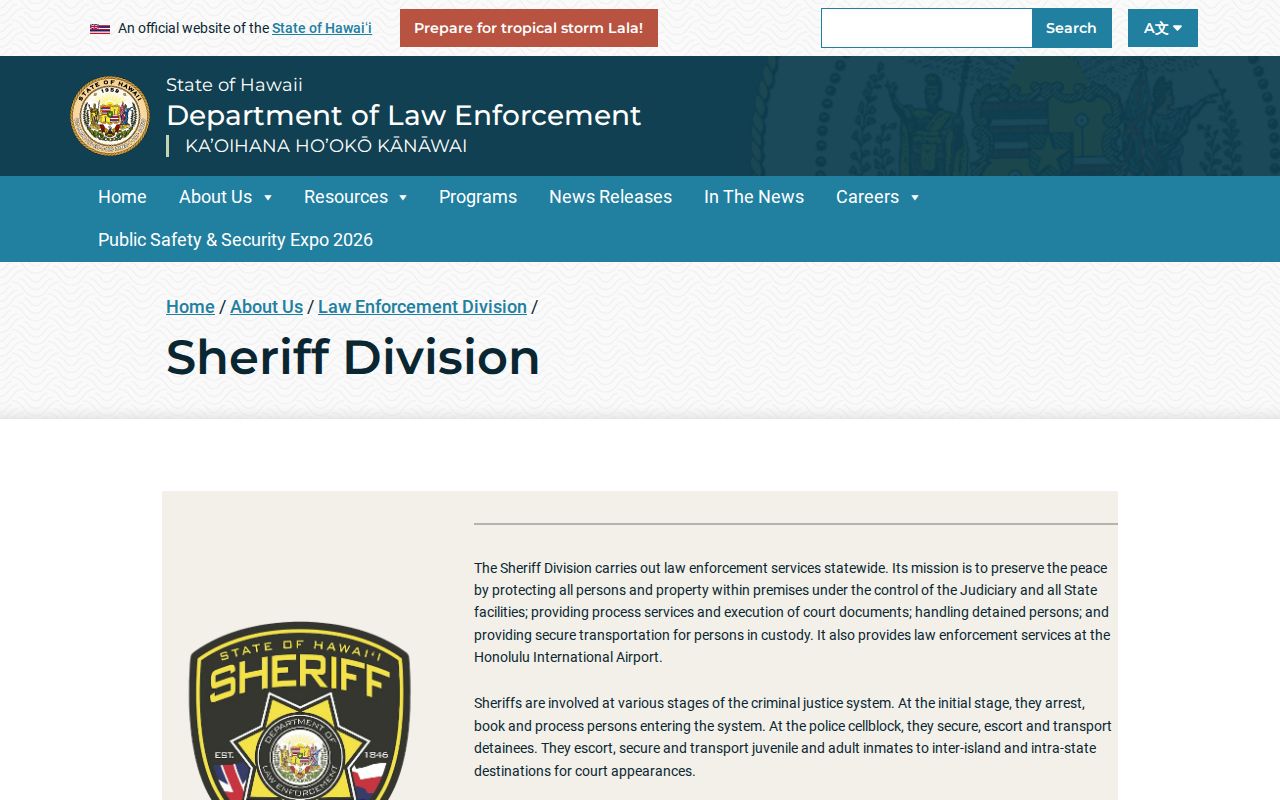
Bring a state-law-enforcement or court-process question to the DLE Sheriff Division. For a Honolulu police warrant question, HPD R&I is the right path.
Honolulu County Wanted List Versus Warrant Check
Hawaii's Judiciary runs an eBench warrants page. Don't expect to browse it. Access is limited to approved law-enforcement and criminal-justice users across the state. Updates land several times a day. The system spans traffic, criminal, and non-Family civil warrants. The public still can't log in and look.
HPD's own policy fills in the rest. The R&I Warrants Unit shares warrant details with duly authorized persons. Communications staff can query eBench, HPD records, the DLE Sheriff, other agencies, and NCIC as the situation calls for it. A Na Maka post or a CrimeStoppers card is publicity, not verification. Most active warrants never make a curated wanted list at all.
Think a warrant carries your name? Call HPD R&I at 808-723-3258 and ask what identification or authorization they need. Then loop in the court or a lawyer. Don't let a web listing drive decisions about hiding, confronting officers, or dodging service. The real answer comes through counsel, the issuing court, and the responsible agency.
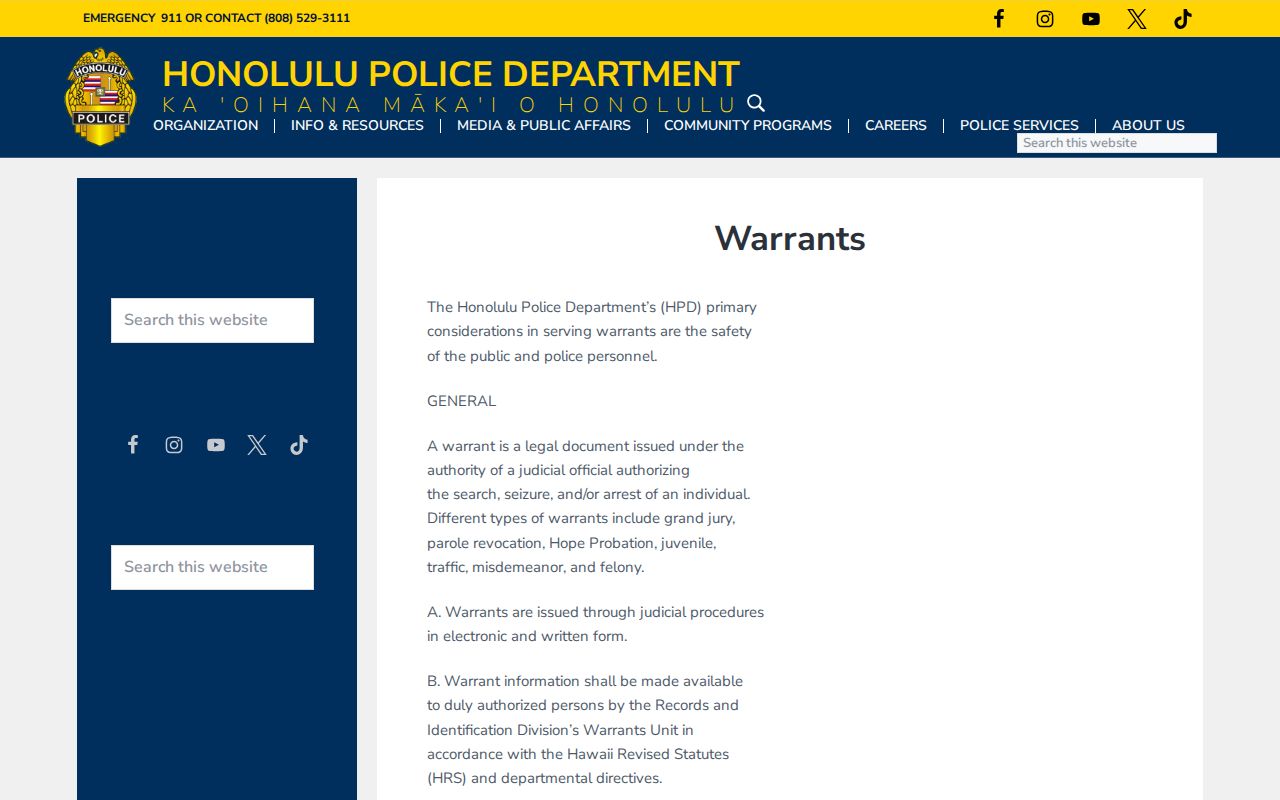
Keep the two tasks straight. A warrant check and a mugshot lookup answer different questions. For a recent arrest, look to the HPD adult arrest log and the later court record.
Honolulu County Warrant Types
HPD policy recognizes several distinct warrant categories. Knowing the label helps in one way. It points you to the court or agency that should confirm a status. The label alone says nothing about where a case stands today.
| Type named in HPD policy | Verification point |
|---|---|
| Grand-jury warrant | Confirm with the responsible criminal-justice or court agency through the authorized public path. |
| Parole-revocation warrant | Ask the relevant corrections or law-enforcement custodian; it is not a routine HPD booking-log field. |
| HOPE probation warrant | Confirm through the appropriate court or agency, not a third-party list. |
| Juvenile warrant | Special confidentiality and authorization limits apply. Do not infer public access from an adult list. |
| Traffic or misdemeanor warrant | Confirm with the court or HPD path named by the Judiciary and HPD. |
| Felony warrant | Use HPD R&I, the issuing court, and counsel for a current and safe response. |
The Hawaii Department of Corrections and Rehabilitation, or DCR, matters once someone is in state custody. Its SAVIN tool is built for status notifications, not public warrant searches. Oahu Community Correctional Center is a state jail, not a warrant database. Finding a person in state custody is not the same as confirming an HPD warrant.
Category shapes how you phrase a records request, too. A wanted-page entry can age out. It can shift after a court event, or linger online after the question has moved to a new custodian. The warrant label alone won't say whether service happened, whether bail was set, or how a case resolved. For a current answer, give HPD R&I or the issuing court the person's identifying details and ask which public process applies. Hang onto the date of any older listing so the agency can tell a stale web post from live status.
Resolve a Honolulu County Warrant Safely
Spotted your own name on a wanted page? Save the URL and the date right away. Then reach out to an attorney, the issuing court, or the agency behind the entry. A lawyer can spell out what information is needed and what appearance or surrender process fits your situation. No web page can hand you a safe legal result from a name match alone.
Match the tool to the question. Custody after an arrest in state system? Use DCR/SAVIN for covered status. Federal question? Turn to BOP or ICE. Case outcome? That belongs to eCourt Kōkua. These channels stay separate because custody and the courts are separate systems.
Photos deserve the same care. A wanted image, a booking photo, and a surveillance shot are three different things, and a record request should name which one the source actually holds.
Why the Honolulu County Wanted List Is Split
Honolulu's setup shifted. The state split its corrections functions into DCR and its law-enforcement functions into DLE. Current sources put DCR over jails and SAVIN. DLE Sheriff handles statewide court and facility work. HPD runs Honolulu arrests and local warrant information. That division is why no generic county-sheriff app or single roster fits the island.
HPD's social feeds and Nixle sometimes carry alerts. None of them promise a routine stream of every booking photo, though. Na Maka handles certain suspect-identification posts. CrimeStoppers takes wanted and unsolved-crime tips. Label each source by its purpose so a photo never gets mistaken for a custody result.