
Honolulu County Busted Mugshots: Booking
Every Honolulu arrest starts with an agency. For local adults, that's nearly always the Honolulu Police Department, or HPD. It serves the consolidated City and County of Honolulu. Under HPD policy, officers log booking details with an arrest report and offense tracking number first. Then comes the photograph and fingerprints. The mugshot gets tied to that report. Booking can happen at a district station, at Central Receiving Division, or at a correctional facility when a warrant is involved.
Those steps create several records. They don't all live in one place. The HPD adult arrest log is a chronological public record, not a live jail roster, and it carries no public photo link. HPD's Records and Identification Division, called R&I, handles photo requests separately. Someone who can't post bail may move from a district facility or CRD into Hawaii Department of Corrections and Rehabilitation custody, which includes Oahu Community Correctional Center. Others go free during police processing. One more wrinkle matters here. The statewide Sheriff Division sits under the Hawaii Department of Law Enforcement, so it is not a Honolulu County sheriff and does not publish the HPD log.
Ask the right custodian for the right thing. HPD holds the arrest entry. R&I holds photos and older logs. DCR/SAVIN covers state custody. The Hawaii Judiciary tracks case activity.
The HPD arrest-log index is the county's real starting point. It links six-hour adult arrest-log PDFs rather than a face gallery. The screenshot below shows the index and its record path, not a collection of booking images.
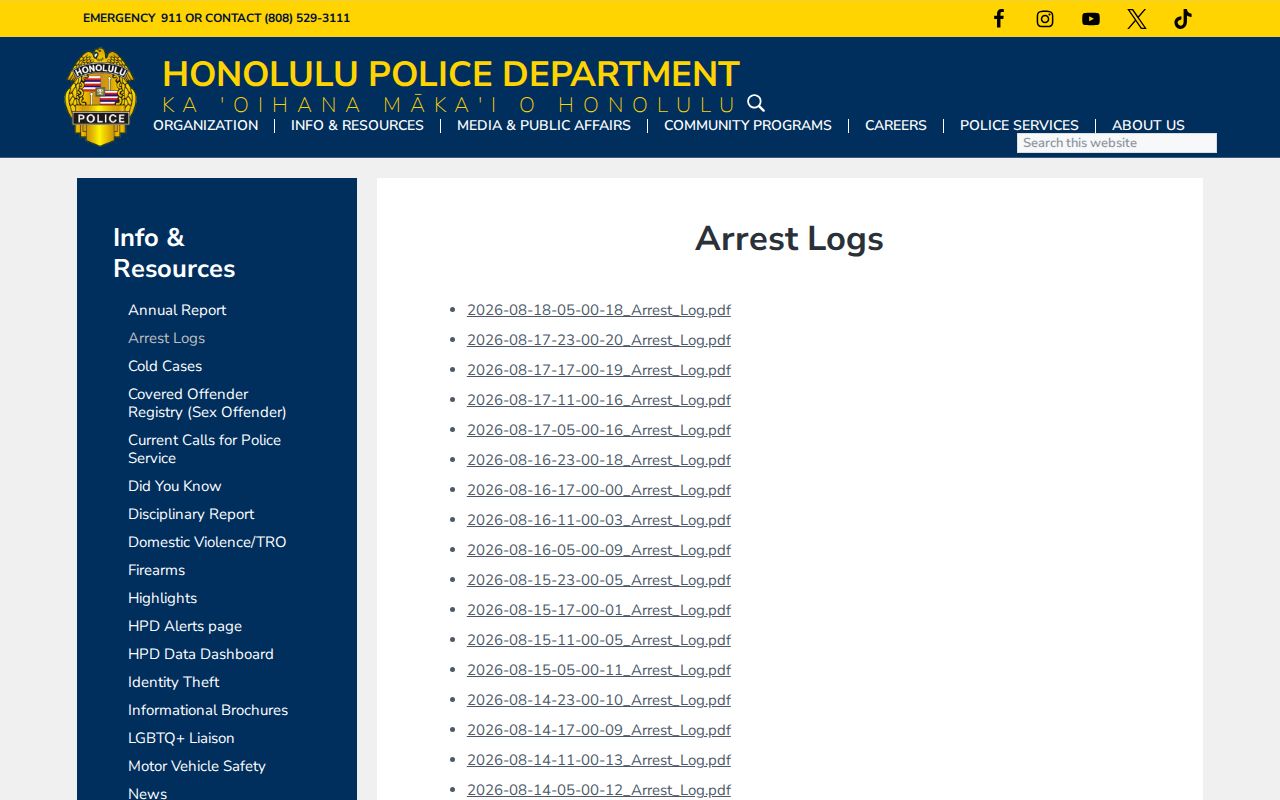
The official index works well for recent adult arrests. A booking photograph follows a different path through R&I. Context matters here. A person just booked may still sit in police holding. Someone released may have dropped out of a current-custody tool. A sentenced person belongs in a state or federal locator instead.
What a Honolulu County Booking Record Shows
HPD's public-access policy spells out which fields a public arrest-log entry can carry. Each line reflects what officers recorded at arrest. Release information may be added afterward. One caution applies. The PDF batch timestamp shows when HPD published that file, not the arrest time for each person inside it. A report number can help R&I find the underlying report. Still, the public log doesn't guarantee every internal booking field will show up.
| Public record item | What it tells you |
|---|---|
| Name | The name entered on the adult arrest-log line. Spelling and identity should be confirmed with R&I when needed. |
| Arrest date and time | The line-level time of arrest. Do not replace it with the six-hour PDF publication timestamp. |
| Age, sex, and race | Identifying fields listed by HPD's public-log policy. |
| Arresting officer | The officer field connected to the arrest entry. |
| Nature of offense | The charge recorded at booking. It is not a court finding or final disposition. |
| Report number | An identifying number that can support a later records request. |
| Release information | A later process clue when HPD adds it. It may use the local release-code key. |
| Booking photograph | A photograph is taken in the booking workflow, but the public log has no ordinary photo link. Request it separately through R&I and HPD-434. |
The release key takes some decoding. RBL means bail or bond, ROR means release on own recognizance, RNC means no charge or formal charges, RPC means prosecution declined, and RPI means pending investigation. TOT marks a transfer. ISC identifies the Intake Service Center, where detainees move on to OCCC after court, while DCT, CCT, and FCT point to District, Circuit, and Family Court arraignment paths. PVC describes prosecution through a complaint or identification process.
Don't expect a public HPD PDF to include a booking number, bond amount, court date, holding facility, or current custody location. Those details may sit in an internal or separate record. The HPD public-access policy and the responsible record custodian decide what can actually be verified.
Request a Honolulu County Booking Photo
No mugshot comes attached to the arrest-log index. A booking photo is a separate R&I transaction. It's governed by the release-of-arrested-persons photographs policy. That policy names the Request for Mug Photographs form, HPD-434. It requires identity verification before any photo goes out. It also applies a one-year/nonconviction review. The policy sets no flat photo fee and promises no turnaround time.
- Identify the person, approximate arrest date, arresting agency, report number if known, and the exact photograph or arrest record requested.
- Use the HPD-434 path through Records and Identification. Include the identification that HPD requires and a way for R&I to contact you about the request.
- Ask R&I for the current estimate for any photograph or enlargement charge. Honolulu Code §6-11.1 treats photographs and enlargements at the prevailing commercial rate, while ordinary document copies use a separate schedule.
- Allow the custodian to review case status, nonconviction information, expungement, redactions, and any other public-record limit. Do not treat a release or a dismissal as an automatic photo-release order.
- If the online arrest log is older than the public window, make a separate written date-specific request for the log. A photo request and an older-log request are related, but they are not the same record transaction.
HPD Records and Identification
801 South Beretania Street
Honolulu, HI 96813
808-723-3258
HPD publishes Records Unit hours: Monday through Friday, 7:45 a.m. to 4:00 p.m., closed on weekends and state holidays.
DCR public-record fallback
Office of the Director
1177 Alakea Street
Honolulu, HI 96813
808-587-1288
| Request item | Published charge or timing |
|---|---|
| HPD document copy | $0.50 for the first page and $0.25 for each additional page. |
| Verification copy | $1 for the first page and $0.25 for each additional page. |
| Color copy | $0.65 per page. |
| Booking photograph | Prevailing commercial rate for photographs or enlargements; ask R&I for the current estimate. |
| UIPA response | OIP describes a general ten-business-day response framework, with a possible additional period for extenuating circumstances and lawful fees. |
The Hawaii Office of Information Practices suggests putting any request in writing. Send it to the agency that keeps the record. Name the record, give a date range, and include your preferred delivery method and contact details. Keep the request narrow and purpose-neutral. HPD may redact material. It generally releases reports once an investigation wraps up and the case closes.
Hawaii Busted Mugshot and Record Law
Hawaii has no stand-alone pay-to-remove mugshot statute. A 2024 bill, SB2631, never became law, so treat it as a proposal only. The real framework comes from a few places. Think of the Uniform Information Practices Act, HPD's photo-release policy, the criminal-history limits in HRS Chapter 846, and expungement under HRS §831-3.2. The OIP UIPA overview notes that a government record can be visual, electronic, or physical. Each record still gets its own access review.
Two OIP opinions do heavy lifting here. Opinion 91-04 opened county arrest logs to inspection and copying. Opinion 94-12 treated police booking photos as public government records. Later guidance and HPD's current policy layer on exceptions for expunged arrests, nonconviction data, identity checks, and case-specific withholding. HRS §846-1 defines criminal-history record information broadly. HRS §846-9 limits how nonconviction data can be shared. None of this wipes an arrest PDF on day one, and not every photo request gets granted.
HPD's web logs rotate out after 14 days online. That window is not a destruction date for the underlying report. Someone eligible can seek expungement through HRS §831-3.2. Hawaii Courts guidance says the application route moved to the Attorney General and the Hawaii Criminal Justice Data Center starting July 1, 2025. The statute covers returning fingerprints and photographs. It keeps an expunged record confidential except for limited authorized inquiries.
For an unofficial publisher, start with the source record and formal paperwork. RecentlyBooked offers a free correction and removal policy. It covers wrong-person, incorrect, outdated, dismissed, expunged or sealed, juvenile, and duplicate entries, and asks for the page URL, name, arrest date, county, reason, and proof where applicable. Mugshots.com posts a record-maintenance policy, though its Honolulu category can sit empty. Busted Newspaper's Honolulu URL may return a 404, Arrests.org a 403 block, and Mugshots.zone a redirect to its root page. Never assume local coverage from another state's page.
A search engine is just an index. Google's official outdated-content process can refresh a stale result after a source changes, but it cannot touch a live court record or erase an active entry. Skip unverified paid removal providers. Source correction, the Hawaii Courts expungement path, and a direct agency request are the routes that actually work. The current HRS Chapter 481B directory, HRS §846-1, and HRS §831-3.2 carry the official text, which controls if a rule changes. The law screenshot below shows the statutory path, not any person's photograph.
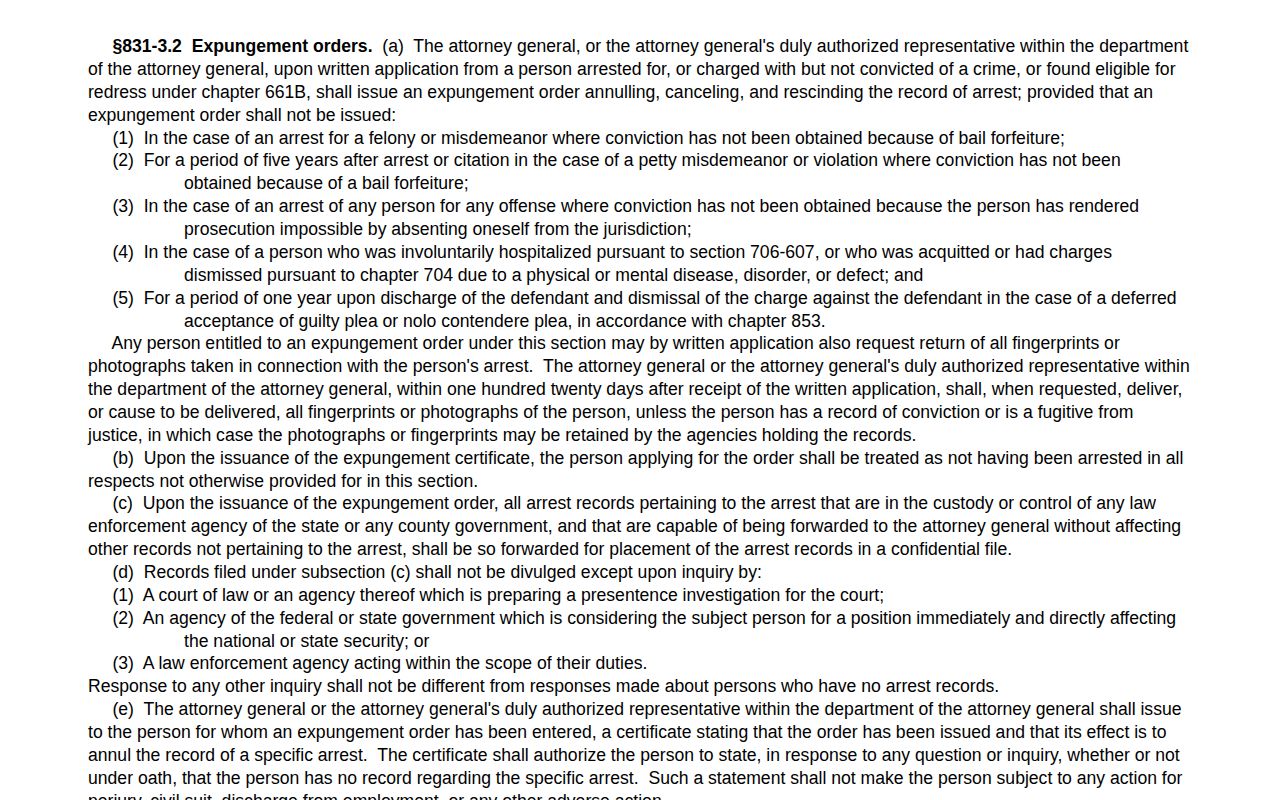
The distinction between public access, photo release, nonconviction limits, and formal expungement matters far more than any label like "public mugshot." Each path answers a different question, and confusing them leads people to the wrong office.
Find Honolulu County Busted Mugshots
Start a name search with the record type, not a national image site. For a recent adult HPD arrest, the countywide PDF log is the right tool. For current DCR custody, use SAVIN/VINELink. For the legal outcome, eCourt Kōkua answers it. No public photo link appears in the HPD feed, so a separate photo request fills that gap.
- Start with the HPD adult arrest-log index and choose the date and six-hour batch that covers the arrest.
- Read the name, arrest date and time, nature of offense, report number, and any later release code. Treat the charge as an charge.
- Use HPD R&I and HPD-434 for a booking photo or an older arrest-log date. Ask for identification, redaction, and fee requirements.
- Use Hawaii SAVIN/VINELink only when current covered DCR custody or a notification is the question. It is not an HPD booking-photo roster.
- Use eCourt Kōkua and JIMS for charging, arraignment, dismissal, acquittal, conviction, or sentence information.
- Use BOP or ICE only if the custody agency is federal or immigration-related. Use the responsible agency's request route when the online source does not answer the question.
Most-wanted pages and media stories add color, not completeness. A wanted listing is not an arrest entry. A news story is not a full feed. Use both alongside the official sources, never instead of them.
Where Honolulu County Busted Mugshots Appear
Honolulu's source landscape is split. Official sources come first, and each one answers a different custody question. The secondary rows below are discovery aids only. They can be stale, incomplete, empty, blocked, or redirected, and they create no official roster.
| Channel | Photo? | Official? | How to use it |
|---|---|---|---|
| HPD adult arrest-log index | No public photo link | Yes | Browse six-hour PDF batches for recent adult HPD arrests. |
| HPD R&I and HPD-434 | Request path | Yes | Request an identifiable photo or older log, subject to policy review. |
| DCR SAVIN/VINELink | No | Yes | Check covered state custody and enroll for status notices. |
| eCourt Kōkua/JIMS | No routine booking photo | Yes | Follow the case after booking and check documents when available. |
| BOP and ICE locators | No standard public photo | Yes | Use only for federal or immigration custody questions. |
| Hawaii News Now, KHON2, KITV, Star-Advertiser | Article-specific | No | Read a story for context and credit, then verify the official record. |
| RecentlyBooked Honolulu County | Cards or placeholders may appear | No | Use only to locate a date or source; compare with HPD and court records. |
| Mugshots.com Honolulu category | Empty when checked | No | Do not treat the state category or policy page as Honolulu coverage. |
| Busted Newspaper, Arrests.org, Mugshots.zone | Not verified locally | No | Expected local URLs were 404, blocked, or redirected as checked. |
A news photo and an HPD photo are not the same thing. An outlet may get an agency image for one story. That does not mean every adult in the HPD log has a public image.
RecentlyBooked's free correction policy helps with that publisher. It is not an official Honolulu record process. Other sources may respond differently, so bring the publisher's own policy plus formal source documentation.
Stick with the official paths: HPD, DCR, Judiciary, and the courts. Skip commercial removal providers entirely. A stale search result should only be handled after the originating record actually changes.
Busted and Booked: Honolulu County Roster
There is no single public roster of current inmates in Honolulu County. That's the honest answer. HPD does not post booking cards with bond amounts and photos, and the OCCC website only names the jail and lists its contacts. SAVIN and VINELink track custody status, not mugshots. HPD's adult arrest log covers past arrests, not who sits behind bars right now.
The gap is real, not hidden. Someone may sit in temporary HPD detention, walk free after processing, move to DCR custody, or fall under another agency entirely. A generic sheriff search makes this worse, since people often mix up the statewide DLE Sheriff Division with HPD and DCR. First step: find out which agency holds the person.
| Official channel | Search fields and limits |
|---|---|
| HPD arrest-log PDFs | No public name, time, or location search form. Choose a date and six-hour PDF, then read name, age, sex, race, arrest date/time, officer, offense, report number, and later release data. |
| SAVIN/VINELink | Search by offender name, offender number, or case as the interface allows. Covers DCR custody and supervision notifications, not every HPD arrest and not photos. |
| BOP locator | Use a BOP register number or exact name with race, age, and sex filters for federal custody. |
| ICE locator | Use an exact A-number and country of birth, or exact name, country of birth, and date of birth. It is not a public image roster. |
- Use the HPD log when the question is a recent adult arrest by HPD.
- Use R&I when the question is a booking photo, report, or older log.
- Use SAVIN when the question is present DCR custody or notification enrollment.
- Use the courts for case status and the BOP or ICE locator only for the matching federal custody state.
Booking at HPD does include a mugshot. Policy confirms that step. Getting the photo is another matter, because the release process runs through R&I and requires identity verification. DCR can also restrict photographs and identifiers under its confidential-information policy for security or management reasons. One more caution applies: if a name drops off a log or SAVIN returns no match, the underlying arrest record still exists somewhere. Erasure from view is not erasure of the record.
Busted Last Night: Honolulu County Bookings
HPD publishes recent arrests as rolling six-hour adult arrest-log PDFs. Fresh batches go up daily from public affairs. The online index runs about 14 days deep. The August 17, 2026 23:00 batch shows the format: a publication timestamp, not the exact moment each entry was created.
Want a wider view? The older six-hour files stay visible on the official index for a while. There is no separate weekly blotter. Per the public-access policy, web and security-post logs rotate out 14 days after issuance. Once a date ages out, send a written date-specific request to R&I. HPD offers no phone or walk-in lookup for older log dates.
Each batch lists name, age, sex, race, arrest date and time, arresting officer, nature of offense, report number, and later release details. It says nothing about current custody, photos, or how a case ended in court. A listed person may have been released, transferred, or picked up by another agency since publication.
The feed screenshot below shows how the public window is laid out. Treat it as an interface record, not a mugshot gallery.
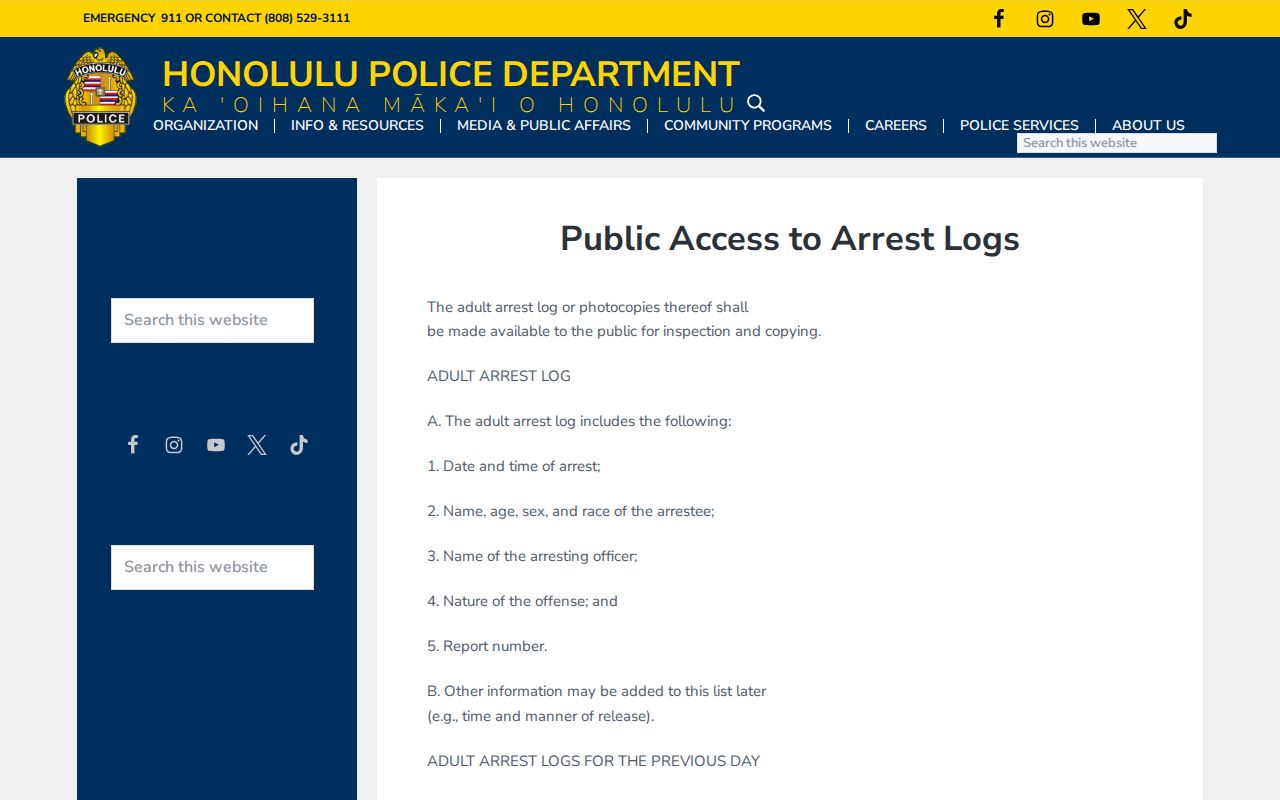
Here's the practical split. Use the same-day batch for a fresh arrest, the remaining multi-day files for short historical reach, and a written R&I request for anything older. An unofficial archive can help pin down a date. The agency copy is still what you verify against.
Busted Booking Custody and Photos
Hawaii's Department of Corrections and Rehabilitation draws a clear line between jails and prisons. Jails hold people pretrial or on short terms. Prisons hold those already sentenced. OCCC is the main state jail on Oahu, at 2199 Kamehameha Highway, Honolulu, HI 96819, reachable at 808-832-1777. Not every HPD arrestee lands there, though. Some stay in a police holding facility, get released, or transfer somewhere else entirely.
For custody status, Hawaii SAVIN points to VINELink at 1-877-846-3444, plus a mobile app and phone, text, email, or in-app alerts. Searches run by name, offender number, or case details. The service is free and built for status updates covering DCR custody or parole. It won't show a local station hold, every released person, federal custody, ICE custody, or an HPD booking photo.
No public DCR offender-photo search exists. The DCR Office of the Director takes UIPA requests. But the confidential-information policy allows photos and identifiers to be restricted or redacted for security reasons. A SAVIN name match is not a promise of a picture. The screenshot below shows the state's custody-notification route, a status tool rather than a county roster.
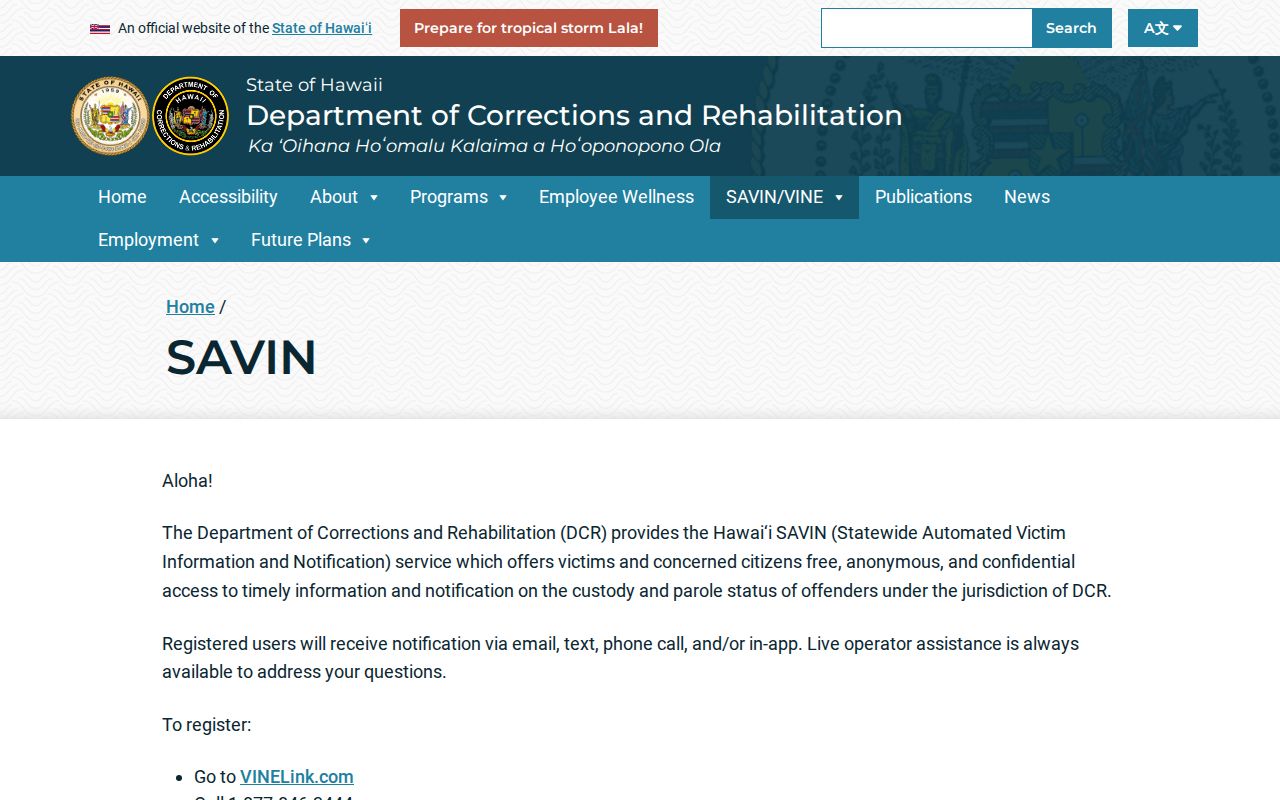
Federal custody runs on separate rails. The BOP locator finds federal inmates from 1982 forward but shows no booking photo. ICE relies on exact identifying fields and follows its own immigration path. Neither result counts as an HPD booking.
Booked or Released: Where Records Live
Labels keep the search honest. The arrest log is history. The state locator is status. The court docket tracks the case itself. One person can pass through all three systems, and none replaces the others.
| Custody state | Best official path | What the result means |
|---|---|---|
| Just arrested or temporarily held by HPD | HPD adult arrest-log PDF | A recent public arrest entry may appear after publication. It is not a live location and may have no photo. |
| Released by HPD | HPD log, R&I, and eCourt | The person may leave a current-custody question, while the arrest entry and separately requestable photo can remain records. |
| Held in DCR/OCCC | SAVIN/VINELink | A covered state-custody status may appear. SAVIN is not a photo roster. |
| Sentenced to state custody | DCR/SAVIN and court records | The state-corrections record is different from the initial HPD booking record. |
| Federal or ICE custody | BOP or ICE locator | A federal or immigration result does not establish a Honolulu HPD arrest. |
OCCC's address and the federal FDC Honolulu address help you name a facility. But a facility page is not a photo lookup. Check current custody through whichever agency actually holds the person. An old HPD log line should never be cited as a current location.
After the Bust: Honolulu Court Records
eCourt Kōkua is where a booking turns into a court file. It covers District, Circuit, and Family Court cases. The basic case details cost nothing. Want the actual paperwork? A PDF-icon document runs $3 for the first 30 pages, or ten cents a page if that costs more. Filings can lag, though, so give a document three business days before expecting it online. JIMS public terminals run 4:00 a.m. to midnight Hawaii time Monday through Saturday, and from noon on Sunday.
A docket can hold plenty: complaint or indictment, arraignment, bail terms where public, hearings, pleas, trial results, sentences, and anything filed later. No PDF icon just means the paper isn't online. It doesn't mean the case never happened. A few gaps exist. Traffic cases predate November 1995 online, District Court criminal cases before August 2012, and appeals before September 2010. Sealed or confidential material never appears here at all.
For the portal itself, the Hawaii Judiciary access page lays out how eCourt Kōkua works, what the document icons mean, the fees, and the limits. It's the quickest way to move past a headline and into the actual court record, and it beats guessing about a case from a photo circulating online.
Busted Mugshots by Honolulu City Area
Honolulu County's three city pages are search labels, nothing more. The City and County of Honolulu is one consolidated government. The places listed are Census-designated places, not independent cities with jails of their own. Each one is served by HPD. Every arrest flows through the same countywide log and the same R&I photo process, so the geography changes the label, not the system.
- Honolulu Busted Mugshots covers Urban Honolulu CDP, HPD District 1, the central city area, and countywide records.
- East Honolulu Busted Mugshots covers East Honolulu CDP, HPD District 7, and the same HPD log and photo request path.
- Pearl City Busted Mugshots covers Pearl City CDP, HPD District 3, its local station, and the centralized county record route.
None of those districts puts out its own arrest-log PDF or a city-level mugshot roster. A neighborhood beat may make the arrest, but HPD R&I holds the records process, and DCR takes custody after any transfer. A local news story can name a street corner. Still, the official record stays countywide no matter where the incident happened.
When Honolulu County Photos Are Taken
HPD's own arrest-report policy answers the timing question directly. Booking information goes in first, tied to the arrest report and its offense tracking number. Then the person is photographed and fingerprinted, and the photo links back to that report. If the normal system is down, an authorized camera can step in. So the snapshot happens during booking itself, not whenever a public PDF later shows up.
That timing comes with no promise about posting delays. One person gets photographed and released after processing. Another moves to CRD or a state facility. Even when the arrest log is already public, the photograph itself is a separate R&I request.
Why Busted Records Leave the Web
The HPD six-hour PDF system beats any vague "recent arrests" label for timing. Each new batch gives a same-day view. Older batches stay in the rolling multi-day collection until the web and security-post copies rotate out after 14 days. Treat that as an access window. The underlying report and image live on regardless of what the website shows.
Once a month-old PDF disappears, ask R&I in writing for that date range. HIPONO or another unofficial archive might help pin down a date, but it isn't the custodian and isn't a mugshot source. The official response is what counts.
Honolulu Custody Alerts Without Photos
Hawaii SAVIN/VINELink is the only official app-style custody channel identified for the county. Alerts arrive by phone, text, email, or in-app notification. The service covers DCR custody along with parole status. HPD social accounts, Nixle, Na Maka, and CrimeStoppers fill other roles: communication, suspect identification, tips. There is no Honolulu sheriff booking app. The DLE Sheriff division serves the whole state, while DCR runs SAVIN. HPD's Crime Incidents open-data snapshot updates daily, but it tracks incidents and calls for service, not arrests, warrants, or booking photos.
Reading a Honolulu Release Code
HPD's release legend turns the arrest log into something readable. RBL means bail or bond posted. ROR is release on own recognizance. RNC signals no charge, and RPC means prosecution declined. RPI leaves things pending investigation. TOT marks a transfer. ISC points to the Intake Service Center with a later OCCC move after court. DCT, CCT, and FCT describe court-arrangement paths, while PVC covers prosecution by complaint or identification. A code is a clue about process, not an outcome. Pair it with eCourt and the agency holding the next record. Someone released may drop out of a current custody search even though the log itself stays requestable.
Records Honolulu County Does Not Show
Some records simply never reach the public side. Juvenile arrest information sits outside the adult HPD arrest-log path. Expunged or sealed entries get handled differently from ordinary public ones. UIPA can force redaction or withholding, and DCR can restrict material when disclosure threatens security or management. A missing line or photo is just that: missing. Don't fill the gap with an assumption.
Custody searches need the same caution. SAVIN may not surface a local hold. BOP and ICE run entirely separate systems. A court PDF that's absent could reflect an online cutoff or a sealed document. The responsible custodian can explain what exists and why part of it stays closed.
HPD, DCR, DLE, Federal: Separate Custody
Custody in Honolulu County is split across several agencies. HPD makes the local arrests. The state's Department of Corrections and Rehabilitation runs the jails and prisons, including OCCC. DLE's Sheriff Division handles court security, transport, and other statewide duties. FDC Honolulu belongs to the federal system, and ICE custody is its own immigration matter.
Always label a record by the agency that produced it. A state locator hit is not a county booking. A federal result is not an HPD mugshot. Getting the custodian right keeps a public arrest line from being mistaken for someone's current whereabouts.
Honolulu County Record Request Costs
Fees are set by rule, not guesswork. HPD posts a schedule for document copies. City code covers photographs. A report's first page runs $0.50, later pages $0.25, and verification copies start at $1. Color copies cost $0.65 a page. Photos and enlargements go by the prevailing commercial rate, so ask R&I for a current estimate rather than assuming a flat mugshot fee.
A UIPA request may also carry a deposit. It can bring a cost estimate or lawful search and copying charges too. OIP allows ten business days for a response, with extra time for extenuating circumstances. Timing still turns on the custodian and the record itself. Ask for one narrow date, person, and report number, and the assessment gets far easier than a request for every booking photo.